
At the shelf
The front sells. Sus reads the back before you pay.
 sus
Skincare scanner
sus
Skincare scanner
The front of the bottle is an ad.
Sus reads the ingredient list on the back and grades it for your Skin ID. Dry, oily, or skin that reacts to everything: your Skin ID can change the letter.
Free to download. The first scan on your iPhone needs no account, and the first three are free.


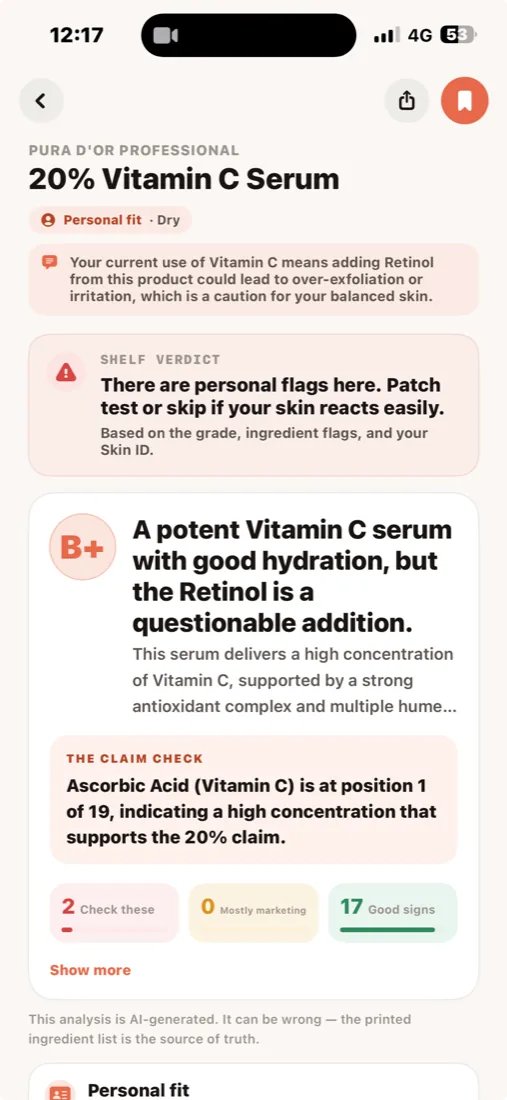
The front sells. Sus reads the back before you pay.
Morning and night, the products you already own, in the order you use them. The full Ritual comes with a monthly or yearly subscription.
Sus doesn't replace your pharmacist. It helps you ask a better question.
About 4 in 10 people say their skin is moderately or very sensitive. Tell Sus what sets yours off, like fragrance, essential oils or alcohol, and Sus grades with it in mind.
Source: a 2020 review of 26 studies in 18 countries, Journal of the European Academy of Dermatology and Venereology.
Turn the bottle around and read the ingredient list. Then ask whether it fits your skin. Sus does that part: it grades the list for your Skin ID. How to check, step by step.
Yes, if you tell it. Pick sensitive in your Skin ID and add what your skin reacts to. A grade is a shopping call, not a patch test. For a reaction that keeps coming back, see a pharmacist or a dermatologist. The fragrance guide.
Some scanners let one ingredient set the score, and many grade on whether an ingredient is present, not how much of it there is. Cosmetic chemists criticise that. Sus grades the list for one Skin ID, yours. How Sus reads a label. How Sus differs, plainly. Comparing the wider field? See the honest Yuka alternatives shortlist.
In the EU and UK, the list runs from the heaviest ingredient down; anything under 1% can follow in any order. The full guide.
It depends where it sits on the list. Near the end, there is likely very little of it, and the front is selling the name more than the dose. What PDRN actually is.
Not necessarily. Pore-clogging ratings mostly come from old rabbit-ear tests, and a product that contains a so-called comedogenic ingredient isn't always comedogenic itself. Sus reads the list itself, whatever the front says. What the claim means.
Save a scan. When you buy it again, photograph the new ingredient list and compare it with the one you saved. How to spot a reformulation.
Free to download. The first scan on your iPhone needs no account, and the first three are free. After that, a 48-hour Shopping Pass or a monthly or yearly subscription. The price is shown before you pay.
No. A scan is a shopping call, not a diagnosis. Reactions that keep coming back belong with a dermatologist.
Next time the front of the bottle starts sounding convincing, turn it around.
Get Sus for iPhone— Sus